
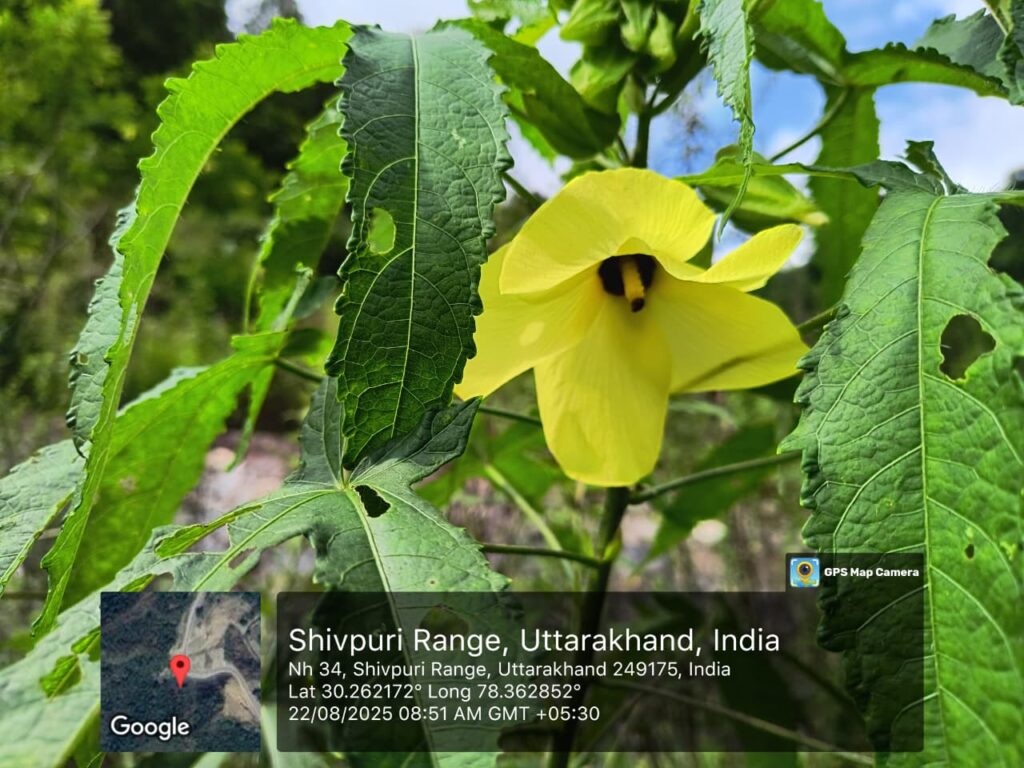
Botanical Name:- Abelmoschus moschatus Medic.
Family:- Malvaceae
English:- Musk Seed, Muskmallow, Ambette Seed
Hindi:- लताकस्तूरी, कस्तूरी दाना, मुष्कदाना
It grows in Bengal, Bihar, Uttar Pradesh and particularly in the warm regions of the country. It is planted in gardens and it also grows wild on its own.
The name of Latakasturi gives us the idea that it is a creeper. It is written in ‘Nighanturatnaakar’ that its creeper is found in the south but the creeper is not seen, it is a shrub only which has been described above. Some scholars write Vedmushk as the synonym of Latakasturi. Actually Vedmushk is different from Latakasturi and its Latin name is Salix caprea Linn. In the texts like Charak, Sushruta etc., it is written that Jatiphal, Katuk, Pug, Kankol, Tambul, Sukshmaila, Lavang and Camphor are used to purify the mouth and to bring taste and fragrance in the mouth. Commentators have interpreted the word Katuk as Latakasturi. Some people have interpreted Katuka as Laghu Kakkakol (chhota kababchini) and Kakkol as Brihat Kakkakol (bada kababchini). Another plant similar to the Latakasturi plant is Hibiscus tetraphyllus Roxb. which is called Dulla. This may possibly be the Ullaka mentioned in Ashtanghridaya (Ch. 8/149).
Its seeds are cold in potency, digestive, aphrodisiac, strength,healthy for eye, thirst reliever and anti-inflammatory.
They are used in cough, bowel disorder, mouth disease, anemia, weakness, malnutrition, Agnimand and fever.
(1) Its extract is given in the quantity of 20 to 40 ml in cough, asthma and fever. It produces smoothness in the respiratory tract and removes the inflammation of the bronchial tubes. Being a stimulant, it also strengthens the heart.
(2) By keeping it in the mouth and chewing it, the mouth becomes clean and fragrant and the appetite increases. Its smoking is useful in hoarseness and stomatitis.
(3) 75 ml. Its tincture is made by mixing seeds and 500 ml alcohol and given in the quantity of 4-8 ml as a stimulant, anti-inflammatory and carminative in debility, weakness and other vata disorders.
(4) Its paste is used as a paste by grinding it in milk for dry itching. Its powder is applied after soaking it in alcohol on snake bite and is also used internally. Applying fine powder in eyes is beneficial.
(5) The juice of its roots and leaves is taken out and mixed with sugar candy and given for gonorrhea, venereal diseases and urinary disorders.
(6) Its seeds are used to make perfume and essential oils.
