
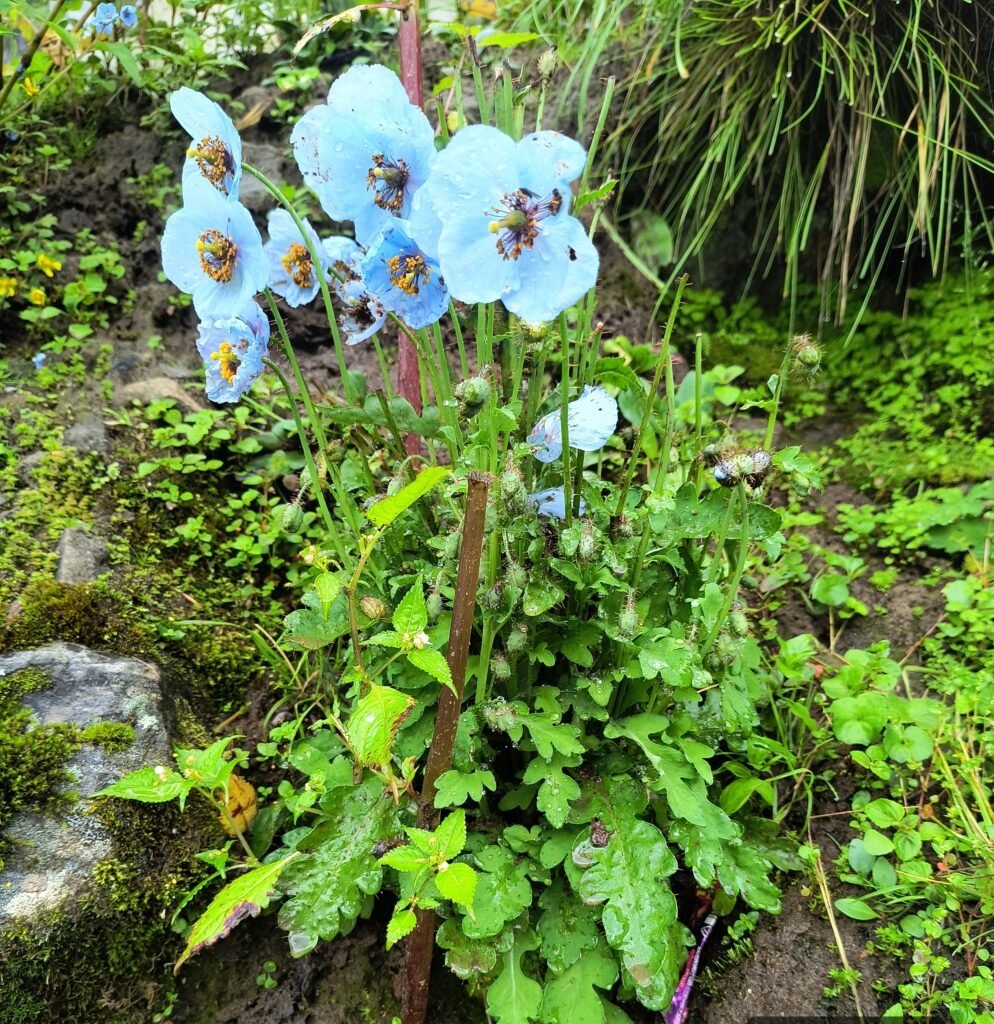
Botanical Name:- Meconopsis aculeata Royle
Family:- Papaveraceae
Sanskrit/ Hindi Name :- वनीता, कान्ता
Common name:– Blue Poppy
Morphological Description:-
Meconopsis aculeata Royle is an endemic, monocarpic, perennial herb characterized by a single, erect, unbranched, hard, and prickly stem, reaching 30–60 cm in height. The plant bears a solitary raceme with numerous flowers.
Flowers are large, showy, actinomorphic, bisexual, complete, and hypogynous. They are shallowly cup-shaped, lateral-facing to semi-nodding, and borne on slender, cylindrical, bristly, erect pedicels measuring approximately 2.5–13.5 cm in length. Petals are usually four, occasionally up to six, delicate, thin, soft, obovate to suborbicular, about 3.7 × 3.7 cm in size, blue-purple in colour, and possess wavy margins.
The stamens consist of filiform filaments, similar in colour to the petals but darker in shade, with golden-yellow anthers. The ovary is globose to elliptic, densely covered with golden-fulvous bristles that are initially appressed and later become ascending to sub-spreading. Styles are distinct, about 1.2 cm long, becoming thickened at the base during fruiting. Stigma lobes are free or connate and oblong to spherical in shape.
The fruit is a spheroidal to elliptic-oblong capsule, densely bristly and many-seeded, dehiscing by (3–)4–6(–8) valves from the apex. Seeds are reniform (kidney-shaped).
The root is napiform or elongated and narrow, measuring approximately 13 cm in length.
Phenology and Habitat:-
Flowering and fruiting occur from June to August. The species commonly grows in rocky habitats, scree slopes, and along stream margins at altitudes ranging from 2,400 to 4,200 m above sea level.
Traditional Uses:-
The whole plant of Meconopsis aculeata Royle is used medicinally in traditional healthcare systems. It is valued for its antimalarial and antibacterial properties and has potential applications in herbal drug development. Traditionally, the plant is employed as a crude drug for the management of rheumatic pain, fever, and various painful conditions due to its analgesic and mild narcotic effects. It is also used in the treatment of bone-related ailments, particularly those affecting the ribs.
The powdered or ground root, mixed with salt, is administered to livestock to enhance disease resistance and improve general health. In folk medicine, the plant is also used for conditions associated with discoloration or bluish appearance of veins.
Additionally, certain traditional communities administer preparations of Meconopsis aculeata Royle to pregnant women with the belief that it helps protect newborns and infants from diseases. However, such traditional claims require scientific validation before clinical application.
