
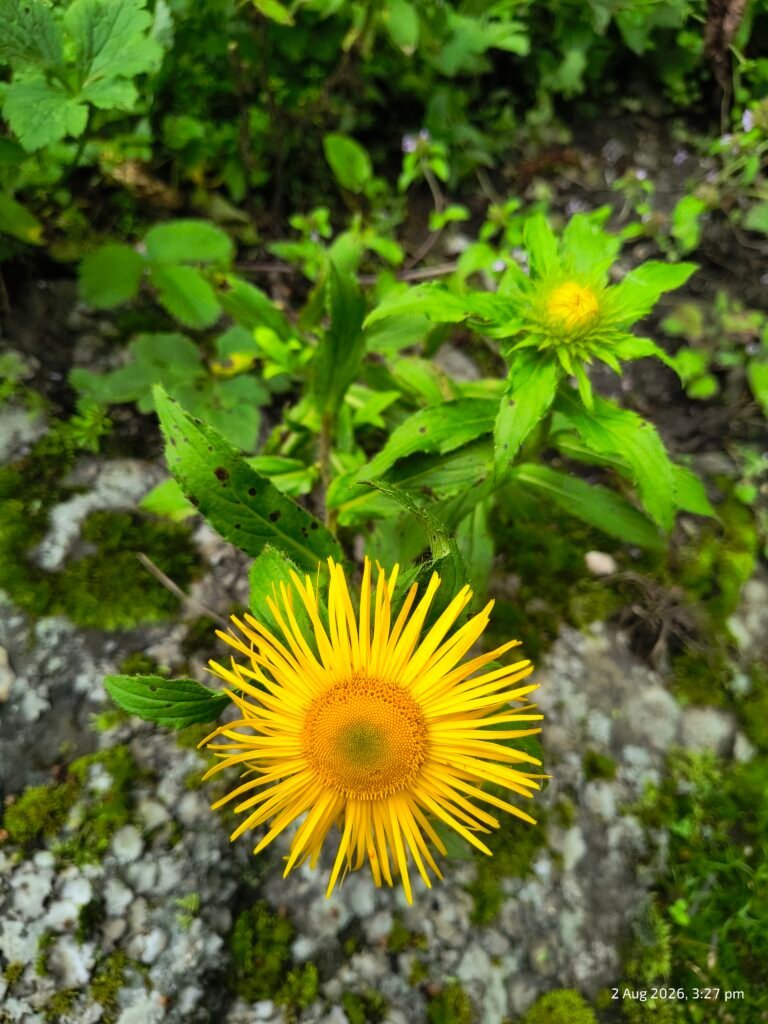
Botanical Name:- Inula grandiflora Willd.
Family:- Asteraceae
Sanskrit/ Hindi Name :- पुष्करमूल
Based on geographical variations, three to four varieties of this shrub are found. It occurs in Kashmir and the north-western Himalayas. In India, it commonly grows in areas where Sugandha Kuth (Dolomiaea costus (Falc.) Kasana & A.K.Pandey) is found. Owing to its similar appearance and co-occurrence with Sugandha Kuth, it is often used as an adulterant or mixed with Kuth in trade.
Morphological Description:-
The plant is a robust shrub growing up to 1.5 m in height. The leaves are coriaceous (leathery), rough on the upper surface, densely hairy beneath, and serrate along the margins. Basal leaves are large, measuring 20–45 cm × 12.5–20 cm, oblong-lanceolate in shape, and borne on long petioles. Stem leaves are ovate-oblong, semi-amplexicaul (partially clasping the stem), and usually deeply lobed at the base.
The flowers are yellow and arranged in clusters measuring 3.5–5 cm in diameter. Fruits are small, slender, and furnished with reddish hairs at the apex.
The root is greyish-brown, hard, and sometimes twisted, gradually tapering downward. It measures about 8–10 cm in length and 2–4 cm in diameter, with a rough and longitudinally wrinkled surface. The cut surface is reddish-white and exhibits a distinct dark-brown cambial ring. White spots are present in the central region. The root breaks with an uneven fracture. It possesses a camphor-like odor and a pungent, irritating taste.
Properties and Therapeutic Uses:-
The plant is regarded as a digestive stimulant, carminative, expectorant, anti-asthmatic, and uterine stimulant. Its decoction is traditionally administered in conditions such as abdominal distension, abdominal colic, indigestion, amenorrhea, dysmenorrhea, pulmonary disorders including asthma, chronic bronchitis, tuberculosis, pleurisy, rheumatoid arthritis (Amavata), and other disorders associated with aggravated Vata. It is also used to reduce fever, inflammation, and pain.
For dermatological conditions such as pruritus and other skin diseases, the decoction is applied externally over the affected areas. The root, triturated with cow urine, is traditionally used in the treatment of itching, ringworm, scabies, and similar skin ailments. It is also considered beneficial in skin ulcers associated with tuberculosis. Furthermore, the plant has been traditionally employed as an antidotal remedy against animal and insect poisons and is valued for its analgesic properties.
