
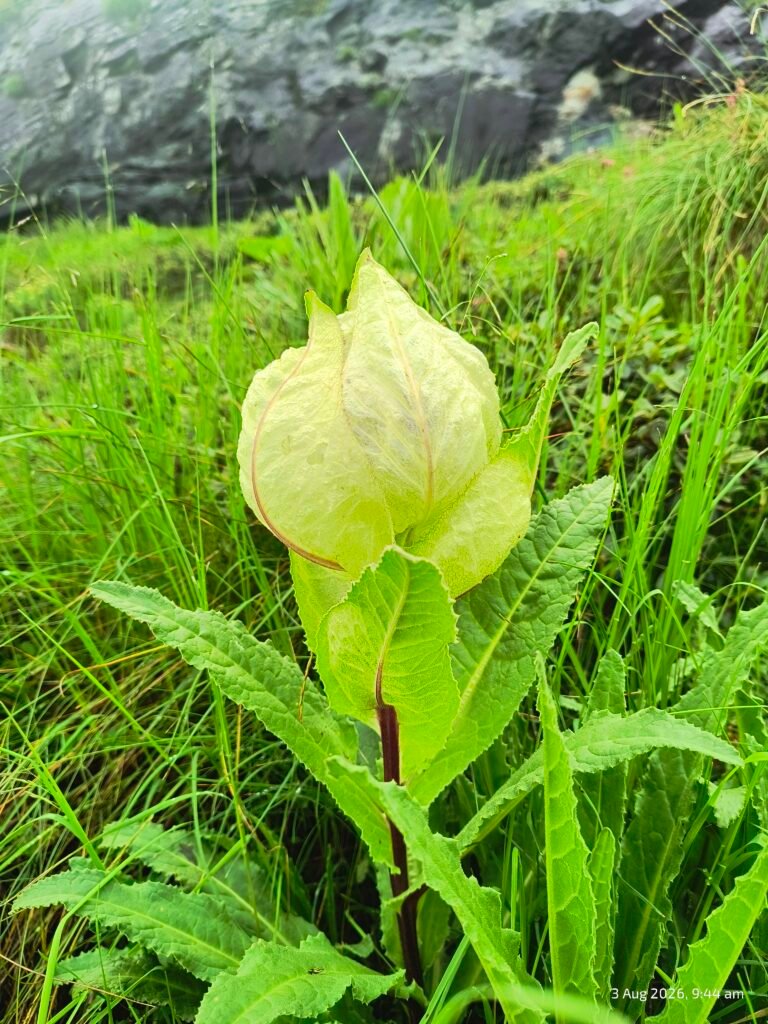
Botanical Name:- Saussurea obvallata (DC.) Sch.Bip.
Family:- Asteraceae
Hindi:- Brahma Kamal
Sanskrit:- Kaurav Padma,Sairandhri Pushpa
Kumaoni (Uttarakhand):- Kapfu
Tibetan:- Gyaltsen Metog (meaning “flower of the gods”)
Chinese:- 雪莲花 (Xuě lián huā), meaning “Snow Lotus”
Nepal:- Brahma Kamal
Bhutan:- Tshering Meto
Brahma Kamal (Saussurea obvallata (DC.) Sch.Bip.), the state flower of Uttarakhand, is an endemic herb native to the Himalayan region, including the Indian Himalayan Region, northern Burma, and southwest China. Brahma Kamal, a species of flowering plant named after Brahma: he Hindu god of creation is considered the ‘king of Himalayan flowers.
Distribution:-
It can be found in the Himalayan mountains of India, namely in the valley of flowers at a height of roughly 3600– 4500 meters, in the regions of Kashmir, Sikkim, Garhwal, Chamoli, and Hemkund. Brahma Kamal is grown outside of India in East Tibet, Pakistan, Bhutan, Nepal, and Myanmar.
Morphological Description:-
A stout, erect annual herb, 15–45 cm tall, with a simple stem that is slightly hairy or nearly glabrous. The stem terminates in a distinctive inflated, bladder-like cluster of translucent, prominently veined upper leaves, forming a pale head measuring 7.5–15 cm in diameter and enclosing 2–6 flower heads.
Leaves are 10–20 cm long, glabrous, obtuse, and toothed. The lower leaves are petiolate, obovate to inversely ovate, whereas the upper stem leaves are sessile, semi-amplexicaul (half stem-clasping), oblong, and concave.
Flower heads are sessile or shortly pedunculate, glabrous, hemispherical, and 1.3–2 cm in diameter. The involucre consists of lanceolate bracts with black tips and often black margins. Corolla about 6 mm long. Anthers possess short, fringed tails.
Pappus brown, approximately 8 mm long; outer pappus bristles rough or sometimes absent. Fruits are achenes, obovate (inversely ovate), ribbed, and glabrous.
Therapeutic uses:-
Dried leaves and flowers are commonly used in the form of a tea or decoction to manage respiratory and gastrointestinal disorders. Powdered preparations are obtained by grinding the dried plant parts into a fine powder, which is usually administered with honey or warm water.
Water decoction: Prepared by boiling the dried plant material in water to extract its active constituents and is commonly used for the management of pain and inflammation.
Herbal infusion: Prepared by steeping the flowers and leaves in hot water and is traditionally used for mild ailments such as colds, as well as a general health tonic.
Traditional Tibetan Medicine: The plant is widely used in traditional Tibetan medicine (Amchi system) and is incorporated into various herbal formulations for promoting longevity, enhancing general health, and managing chronic ailments.
The root is applied to cuts and bruises.
